PHX GOOD · FIRST WEB EDITION
Before the Next Door
September 20, 2026 · PHX Good editorial team · AI-assisted writing
A rose opens one petal at a time. A next step can be small, too.
When someone asks for help, the first thing we hand them is often a list.
But a list leaves work unfinished. Which option fits? What happens when they call? What should they confirm before making the trip? And what can they do if that first path does not work?
PHX Good begins with that unfinished work. We are building for case managers and the wider circle of people helping others: coordinators, outreach workers, first responders, supervisors, and the person who simply wants to help someone take a next step.
The 30-second version
A useful handoff connects four things: the need, a possible starting point, the questions still unanswered, and another path if needed. A resource listing can suggest where to begin. It cannot promise that a service is available or that someone will be admitted.
Four petals. One practical next step.
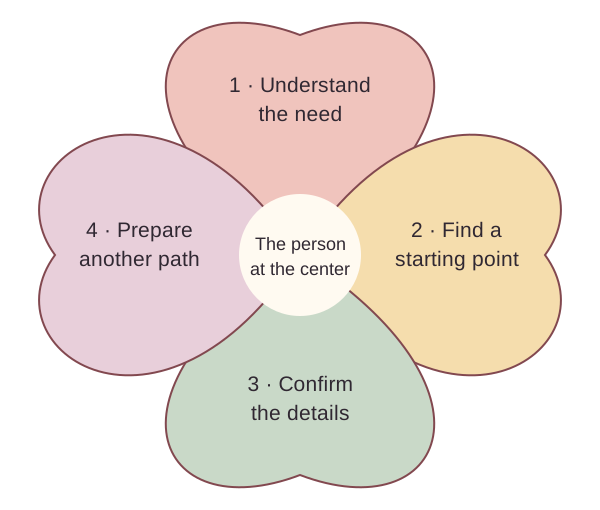
1 — Understand the need. Ask what matters most to the person right now. Notice barriers to taking the next step, such as transportation or reaching someone by phone. Do not assume the answer from the category they selected.
2 — Find a possible starting point. Look for an option relevant to that need. Read what the source actually says, including its limits. A familiar organization name is not enough to establish that a particular service fits.
3 — Confirm the details. Before someone travels, confirm the intake route, eligibility questions and what they should bring. Published hours do not establish current capacity. If a detail remains unclear, keep it visible as a question.
4 — Prepare another path. Agree what to do if the first option is unavailable, unreachable or unsuitable. A fallback is another possible action to confirm, not a guaranteed opening elsewhere.
Diagram text equivalent: understand the need → identify a possible starting point → confirm details → prepare another path. Return to the person's need whenever the answer changes.
Let an unanswered question stay a question
Possible fit → details confirmed? If yes, describe the next action within the scope of what was confirmed. If no, verify before presenting that detail as settled. If the option does not fit, revisit the need and check another starting point.
Consider a fictional practice situation: someone has found a program address but does not know whether the program accepts walk-ins. The useful next step is not automatically “go there.” It is to establish the intake route. If nobody answers, record that the detail is still unconfirmed; silence is not proof that the program is closed or that entry is available.
Three questions before the handoff
- What is the first action this person can take?
- What do we still need to confirm before they spend time or money getting there?
- What will we try if the first route does not work?
A handoff you can use
“A possible starting point is ___. The next action is ___. Before you travel, confirm ___. We still do not know ___. If that option does not work, the next step to check is ___.”
Keep client names and sensitive details out of public feedback. The goal is a clearer action, with uncertainty stated plainly.
Begin with one useful step
Start a case-manager brief to explore a guided starting point. Bring your judgment, confirm the details, and tell us where the experience needs to become clearer.
There is care in finding a door. There is care, too, in checking where it leads.
This is a web edition. Join the update list and help choose what comes next. The signup form shows the current email delivery status.